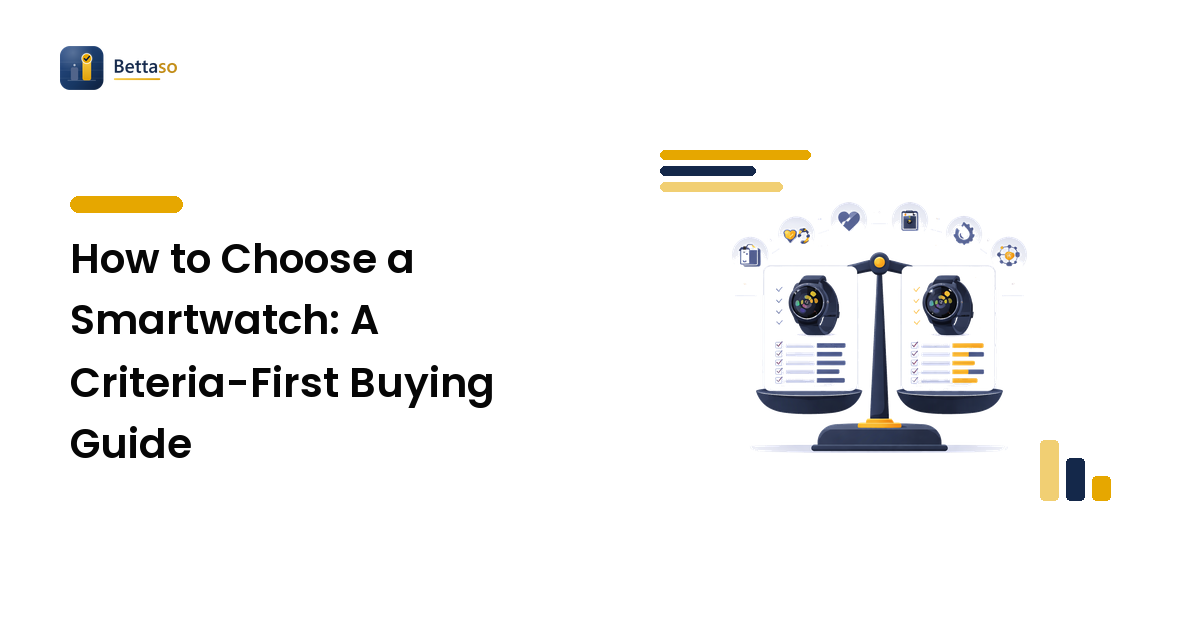
A smartwatch is a purchase built to be decided on impulse: a glossy render, a wall of sensor icons, and a promise that this one will finally make you sleep better and move more. The way to buy well is the same method that works for any considered purchase — decide your criteria before you look at models, weight them by how you'll actually wear the thing, then score each option against them. This guide sets out the criteria that matter, shows how to weight them for different buyers, and applies the method so you leave with the watch that fits your wrist and phone, not the one with the busiest spec sheet.
If you've used a scoring approach before, this is the same discipline that powers a weighted comparison scorecard: make the decision rule explicit before the options can bias you.
Step 1: Set the Criteria Before the Models
For almost every smartwatch buyer, six criteria decide the purchase. Write them down before you open a single product page.
- Phone compatibility — the single most important axis. Some watches only pair fully with one phone platform, and features you paid for can go dark on the wrong phone.
- Health and fitness sensors — heart rate, GPS, blood oxygen, sleep tracking, ECG. More matters only if you'll use it; a runner and a steps-and-notifications user need very different sensor sets.
- Battery life — measured honestly in days of your usage, with the always-on display and GPS you plan to leave on, not the best-case number on the box.
- Durability and build — water-resistance rating, screen glass, case material, and whether it survives a gym, a pool, or a job site.
- Ecosystem and apps — how well it handles payments, music, and the apps you rely on, plus how locked-in the band and charger standards are.
- Budget — the real ceiling, remembering that a mid-priced watch you'll wear for three years beats a flagship you charge twice a day and resent.
Sensor and battery claims are where marketing gets loosest, so this is the stage to gather real specs rather than adjectives. Independent gadget explainers and model round-ups — the kind published by a consumer-tech research hub like Getallneed — are useful here for turning a feature icon into a checkable fact before it ever reaches your scorecard.
Step 2: Weight the Criteria to How You'll Wear It
Different buyers should weight the same criteria very differently. Score each from 1 (nice to have) to 5 (non-negotiable), based on how the watch will earn its place on your wrist.
- Serious runner / cyclist. Sensors ×5, battery ×5, durability ×4, compatibility ×4, ecosystem ×2, budget ×3.
- Everyday notifications and steps. Compatibility ×5, battery ×4, budget ×4, ecosystem ×3, durability ×3, sensors ×2.
- Health-focused wearer. Sensors ×5, compatibility ×5, battery ×3, durability ×3, ecosystem ×3, budget ×3.
- Style-first, light tech. Build/durability ×5, compatibility ×4, budget ×4, battery ×3, ecosystem ×2, sensors ×2.
The weighting is the whole point. A watch that's ideal for a marathoner is the wrong buy for someone who just wants to leave their phone in a bag — and without weights, every model looks "great" in the abstract.
Step 3: Score Each Model Against the Weighted Criteria
For each candidate watch, score it 1–5 on every criterion, multiply by the weight, and total it. Do this with three or four real models side by side and the winner usually stops being a matter of taste: it's the model that scores well on your heavily-weighted axes, not the one with the longest feature list. A watch loaded with sensors you'll never open loses to a simpler one that nails compatibility and battery — if that's what you weighted highest. Keep the scores honest, too: a feature you can't or won't use scores low no matter how impressive it sounds.
Step 4: Read the Specs, Not the Marketing
Smartwatch pages lean on mood words — "advanced," "all-day," "pro-grade." Translate each one into something checkable.
- "All-day battery" → ask under what settings. Always-on display, continuous heart rate, and GPS drain it fast. Find the number for your configuration.
- "Advanced health tracking" → list the actual sensors. Which readings, how often, and whether the ones you care about (like ECG or blood oxygen) are even enabled in your region.
- "Rugged / water resistant" → read the rating. A splash rating is not a swim rating, and a swim rating is not a scuba rating. The number and standard matter, not the word.
- "Works with your phone" → confirm which features survive the pairing. Replies, payments, and notifications sometimes only work fully on one platform.
Step 5: Avoid the Classic Smartwatch Traps
A few mistakes repeat across smartwatch buyers. Watch for them by name.
- Ignoring compatibility until after checkout. This is the most expensive mistake there is — half the features you paid for can be locked to the wrong phone.
- Overweighting sensors you'll never open. Blood oxygen and ECG are only worth points if you'll actually use them.
- Trusting best-case battery numbers. Real-world battery with your settings is often a fraction of the box figure.
- Forgetting the recurring costs. Some health and connectivity features sit behind a subscription; count that in the budget, not just the sticker price.
- Skipping the warranty and band standard. A proprietary band or charger you can't cheaply replace is a slow tax on the ownership period.
A Pocket Checklist
Before you pay, confirm:
- [ ] Criteria are written down and weighted to your use, not a generic reviewer's.
- [ ] Phone compatibility is verified for the specific features you want.
- [ ] Battery life is the number for your settings, not the headline figure.
- [ ] The water-resistance and durability ratings match how you'll actually treat it.
- [ ] Each model is scored, not just admired — and the winner wins on the weighted criteria.
Frequently Asked Questions
How do I know if a smartwatch will work with my phone?
Check the manufacturer's stated compatibility first, and confirm which features — replies, payments, notifications — stay fully functional on your phone platform. This is the criterion most likely to make or break the purchase, so verify it before anything else.
How many health sensors do I actually need?
Only as many as you'll use. A casual wearer is served well by heart rate, steps, and sleep; an athlete benefits from GPS and richer training metrics; someone tracking a specific concern may want ECG or blood oxygen. Score sensors against your real use, not the total on the box.
Is a more expensive smartwatch always better?
No. "Better" only means better on the criteria you weighted highest. A mid-priced watch that nails compatibility, battery, and durability will out-score a flagship whose extra sensors you never open.
How long should a smartwatch last?
A well-built watch with a good water rating and replaceable band should last several years physically; the practical limit is usually software support and battery health. Check how long the maker commits to updates, and treat a locked-in charger or band as a real ownership cost.
Final Thoughts
Choosing a smartwatch is a solved problem the moment you refuse to decide on impulse. Set the six criteria, weight them to how you'll actually wear the watch, score each candidate, and translate every marketing word into a checkable spec. Do the research on real models first — a consumer-tech hub like Getallneed is a handy place to turn feature icons into facts — then let compatibility, battery, and durability carry the decision. Score honestly, and the best-fit watch wins on the criteria that actually decide whether you'll still be wearing it in three years.