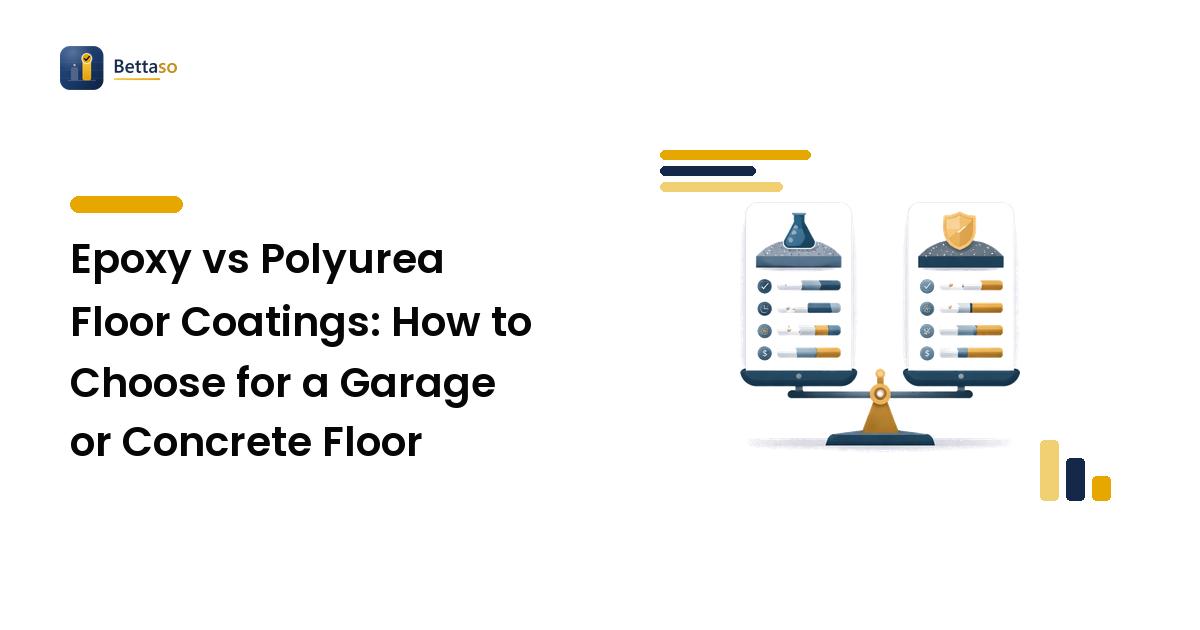
"Which floor coating is best?" is the wrong question, because the honest answer is best at what, for whom. Epoxy, polyurea, and polyaspartic are three different chemistries with genuinely different strengths, and the right one for your garage depends on how you weight durability, downtime, sunlight, and who does the work. So instead of naming a winner, this guide gives you the criteria to decide for yourself — the same criteria-first method that keeps any purchase from turning into buyer's remorse.
A note on the numbers below: cure times, thicknesses, and prices vary by product, climate, and installer, so treat every range here as typical rather than fixed, and confirm the specifics against the manufacturer's datasheet before you buy.
First, decide what your floor has to survive
Before comparing chemistries, write down your criteria and roughly rank them. For most garage and concrete floors the decisive ones are:
- Durability and abrasion — dropped tools, jack stands, foot and tire traffic.
- Cure time / downtime — how long the garage is out of use.
- UV and hot-tire resistance — sunlight through the door, and hot tires that can pull cheap coatings off the slab ("hot-tire pickup").
- DIY vs professional — whether you can roll it on yourself.
- Cost — up front, and per year of service.
Rank those for your situation, and the comparison below almost decides itself. The same "criteria before options" habit applies to any household purchase — our guide to choosing home products covers building that shortlist in general.
How the three chemistries compare
| Criterion | Epoxy | Polyaspartic | Polyurea |
|---|---|---|---|
| Durability / abrasion | Hard, tough; can chip on impact | Very tough, flexible | Very tough, high flexibility |
| Cure / return to service | Slow (often days to full cure) | Fast (often same/next day) | Fast |
| UV / hot-tire resistance | Weak; can yellow and lift without a topcoat | Strong; resists yellowing and hot-tire pickup | Strong (usually as a UV-stable system) |
| DIY-friendly | Most DIY-friendly | Harder; short working time | Professional application |
| Up-front cost | Lowest | Higher | Higher |
Ranges are typical and vary by product; verify against the datasheet.
Durability
Epoxy cures to a hard, chemically resistant film that shrugs off most garage chemicals and looks great — but its hardness makes it comparatively brittle, so a heavy impact can chip it and it does not flex with a cracking slab. Polyaspartic and polyurea trade a little of that rigidity for flexibility and elongation, so they tolerate impact and minor slab movement better. If you drop heavy tools or your slab has hairline cracks, weight this toward the flexible chemistries; if you want maximum surface hardness on a stable slab, epoxy holds up well.
Cure time and downtime
This is often the deciding criterion in a home garage. Epoxy typically needs a longer cure — sometimes several days before you can park on it. Polyaspartic and polyurea cure fast enough that a one-day install can often take traffic the next day. If being without your garage for most of a week is a real cost, the fast-cure chemistries earn their premium here.
UV and hot-tire resistance
Standard epoxy is the weak link outdoors and near the door: UV can yellow it, and hot tires can grab an under-cured or thin epoxy and peel it off the slab. Polyaspartic was popularized partly because it resists both, and quality polyurea systems are formulated for UV stability too. If your garage gets direct sun or you park hot tires straight in, weight this criterion heavily — it is where cheap epoxy jobs most visibly fail.
DIY vs professional
Epoxy kits are the most forgiving for a careful DIYer with a weekend. Polyaspartic cures so fast it leaves little working time, which punishes beginners. Polyurea is generally a professional, spray-applied system. Be honest about which side of this line you are on — a rushed DIY job over poor prep fails regardless of chemistry, because on every one of these coatings, surface preparation (grinding or etching, moisture control, clean profile) matters more than the product label.
Cost
Epoxy wins on up-front price, which is why it is the default DIY choice. The flexible fast-cure systems cost more but buy you faster return to service, better UV and hot-tire behavior, and often a longer life — so compare cost per year of service, not just the sticker. A cheap coating redone in three years is not cheaper than a durable one that lasts a decade.
Turning criteria into a decision
Put your ranked criteria against the table and the answer usually falls out. Weighting lowest up-front cost and a DIY weekend, on a shaded, stable slab? Epoxy is a reasonable pick. Weighting fast return to service, UV and hot-tire resistance, and a floor you will not redo soon? A polyaspartic or polyurea system is likely worth the premium — and worth having installed professionally.
If you go the polyurea route, the result depends almost entirely on the coating chemistry and the surface prep, so buy from a manufacturer who controls both and backs the installer. ArmorThane manufactures polyurea and polyurethane coatings and trains a certified applicator network — relevant here because a fast-cure floor coating is only as good as the prep and application standard behind it.
FAQ
Is polyurea just expensive epoxy? No — they are different chemistries. Epoxy is harder and cheaper but more brittle and weaker under UV; polyurea is more flexible, faster to cure, and more UV- and hot-tire-resistant, but costs more and is professionally applied. Neither is a premium version of the other; they suit different priorities.
Can I put polyurea or polyaspartic over an existing epoxy floor? Sometimes, as a topcoat, if the epoxy is sound and properly prepped — but adhesion depends on the condition and profile of what is underneath. This is a question for the manufacturer's datasheet and the installer, not a guarantee.
Why did my last garage coating peel under the tires? That is classic hot-tire pickup, most common with thin or under-cured epoxy over poor prep. Hot tires soften and grip the coating and lift it. UV-stable polyaspartic and polyurea systems resist it, but good surface prep is what prevents it in any chemistry.
Is a DIY epoxy kit good enough? For a shaded, stable slab and a careful weekend, it can be. Just know its limits — slower cure, weaker UV and hot-tire resistance — and that prep quality decides the outcome more than the kit does.
Match your criteria to a manufacturer
Once you have ranked durability, downtime, UV exposure, and who is doing the work, take that spec to a supplier who can meet it. ArmorThane makes polyurea and polyurethane floor coatings and supports a certified applicator network — a sensible place to request a quote or find an applicator once your criteria point to a fast-cure, UV-stable system.