Search for the best home products and you get a wall of "Top 10" lists, each ranking a slightly different set of blenders, air fryers, sheets, and vacuums as the definitive winner. They cannot all be right, and most of them are not really trying to be: a ranking with no visible criteria is just a set of opinions dressed up as a verdict. The honest truth is that the best home products are not a fixed list — they are the ones that match what your household actually needs, on the dimensions that actually matter to you. This guide gives you the method to find them yourself, so a listicle never gets the last word again.
What "Best Home Products" Actually Means
"Best" is a comparison, and every comparison needs a yardstick. Best at what, for whom, by which measures? A cast-iron pan that is "best" for someone who cooks daily and wants a fifty-year tool is a poor pick for someone who wants something light and dishwasher-safe. Neither answer is wrong — they are answers to different questions.
So before you read a single review, turn the vague question ("what are the best home products?") into a specific one: the best [product] for [my situation], judged on [my top criteria]. That one sentence is your filter. Every feature a product waves at you either serves it or it is noise.
The Criteria That Separate the Best From the Rest
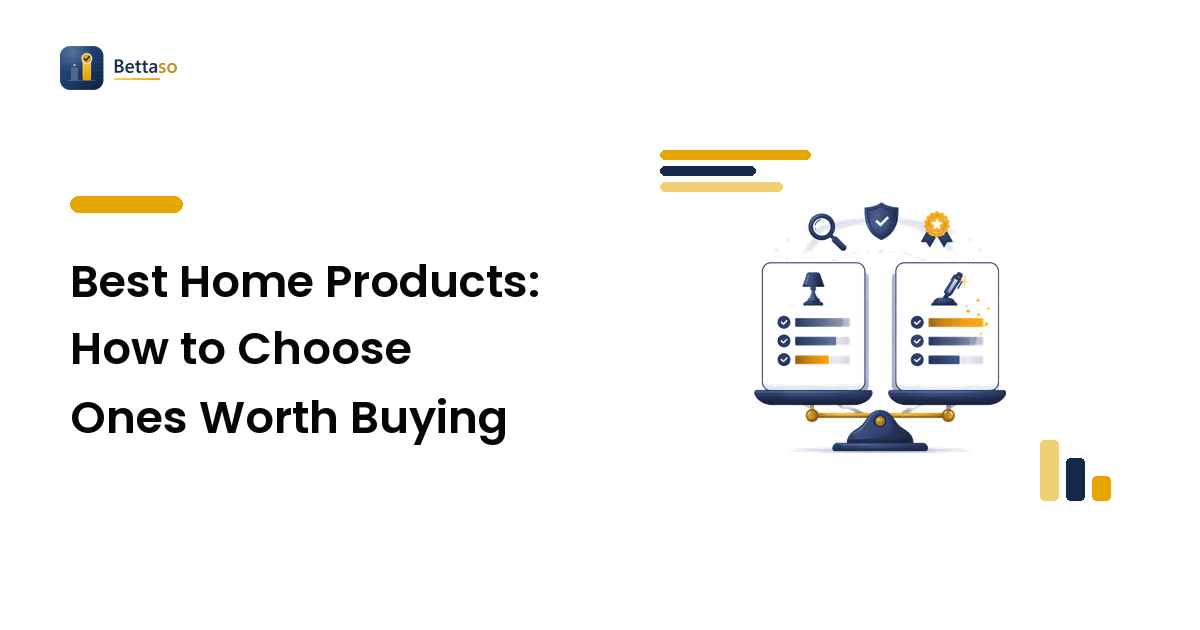
Across almost every home category, the same handful of dimensions decide whether a product earns its place. Weight them for your situation, then score candidates against them:
- Fitness for your actual use. Does it do your job well — the specific thing you need daily — rather than the demo-friendly job on the box? A vacuum tuned for bare floors is not the best if you have three rugs and a shedding dog.
- Specs that map to real outcomes. Learn which numbers matter and which are theater. Capacity, wattage, material grade, and dimensions translate into real-life results; a long marketing spec sheet often does not. Reading a spec table without being misled is a skill of its own — our weighted-scorecard method for comparing products walks through turning specs into scores you can trust.
- Durability. The best home products are usually the ones you do not have to replace. Look for repairable designs, replaceable parts, metal where cheaper rivals use plastic, and honest signals of build quality over a glossy finish.
- Warranty and support. A confident maker backs the product. Read what the warranty actually covers, for how long, and what voids it — a two-year warranty with easy claims beats a "lifetime" one buried in exclusions.
- Total cost, not sticker price. Filters, pods, bags, batteries, and pricey consumables can dwarf the upfront cost. The cheapest product to buy is often the most expensive to own.
Write these down, decide which two or three matter most to you, and you have a scorecard. Now the reviews work for you instead of steering you.
Home Decor: How to Choose Pieces That Last
Decor feels like a matter of taste, and some of it is — but the same criteria-first move keeps you from regret. Before browsing, name the job each piece must do: cover an empty wall, add storage, warm up a cold room, seat guests. Then judge candidates on fit (does it suit your space and the way you live), material and build (will it survive real use), and flexibility (does it still work if you rearrange or move). Buy the anchor pieces — the sofa, the rug, the bed — on durability and comfort, and let the cheap, swappable accents carry the trend. That way your money goes to what lasts and your personality shows in what is easy to change.
Home Decor Ideas Beyond the Trend Cycle
Trend-of-the-year decor ideas are fun to browse and expensive to chase. The steadier approach is to separate the durable layer from the disposable one. Neutral, well-made foundations — quality textiles, real wood, timeless shapes — are the pieces worth investing in, because they outlast any single season. Save the of-the-moment color, pattern, or motif for the layer you can change cheaply: cushions, throws, art prints, a coat of paint. Good decor ideas are not about buying the newest look; they are about building a base that lets you refresh the mood without redoing the room.
What About "Best Home Products 2026" Lists?
Adding a year to a search — "best home products 2026" — usually just adds a timestamp to the same listicle problem. A fresh publish date does not mean the ranking has criteria, and last year's genuinely good product rarely becomes bad because the calendar changed. Use dated lists for one thing only: spotting what is newly available — a model that was not on the market before. Then run any new candidate through the exact same criteria as everything else. A product does not earn "best" by being recent; it earns it by fitting your needs better than the alternatives, this year or any year.
The Same Method Works Beyond the Home — Even for Email Marketing Tools
The reason this approach travels is that it is not really about homeware — it is about deciding well. Say you run a small business and need to choose among email marketing tools. The instinct is to compare feature lists and pick the longest one. The better move is identical to buying a vacuum: define the job (send a weekly newsletter and a simple welcome sequence), pick your top criteria (deliverability, ease of use, price as your list grows, how hard it is to leave), and score the contenders on those. Software has its own quirks — per-seat pricing, tiers, migration costs — but the skeleton is the same criteria-first decision every time.
Requirements First: A Lesson From Getting a Passport
Here is an everyday example of the same principle from a completely different corner of life. When people ask how to get a passport, the ones who breeze through it start by reading the requirements — the exact documents, photo specs, fees, and processing times — before they book an appointment. The ones who struggle show up and improvise. Buying home products works the same way: define your requirements first, and the "how" becomes almost mechanical. Skip that step and you are improvising in a store aisle, which is exactly how the wrong product ends up in your cart.
A Quick Scorecard You Can Reuse
For any home purchase, run this in under five minutes:
- Write the job in one sentence — the specific thing this product must do for you.
- List your top three criteria and mark which one is the deal-breaker.
- Shortlist two or three candidates — no more; comparison paralysis is real.
- Score each on your criteria, using specs and reviews as evidence, not marketing copy.
- Check durability, warranty, and total cost before you commit.
- Buy the one that fits your criteria best — even if it is not the internet's "number one."
FAQ
Are "best home products" lists worth reading at all? Yes — as a source of candidates, not verdicts. A good list surfaces options you had not considered. Just re-judge every option against your own criteria before you trust its ranking.
How do I know if a product is actually durable before buying? Look for repairability, replaceable parts, sturdy materials over glossy finishes, and a warranty the maker clearly stands behind. Long-term reviews that mention how a product held up after a year say more than any first-impression rave.
Should I always buy the most expensive option to get quality? No. Price and quality correlate loosely at best. Match the product to your job and criteria; often a mid-range pick beats the premium one on the dimensions you actually care about.
Does "2026" in a product search mean it is better? Not by itself. A recent date can flag genuinely new models, but recency is not a criterion. Score new arrivals exactly like everything else.
What is the single biggest mistake when buying home products? Comparing options before defining requirements. Decide what the product must do and what matters most first — then the comparison almost makes itself.
The best home products are not the ones a stranger crowned number one; they are the ones that fit your household on the criteria you chose. Get the method right and every future purchase gets easier. When you are ready to see criteria-first comparisons and the Bettaso pick for a category, browse the scored comparisons on bettaso.com — we earn an affiliate commission when you buy through them, and it never changes the scores.