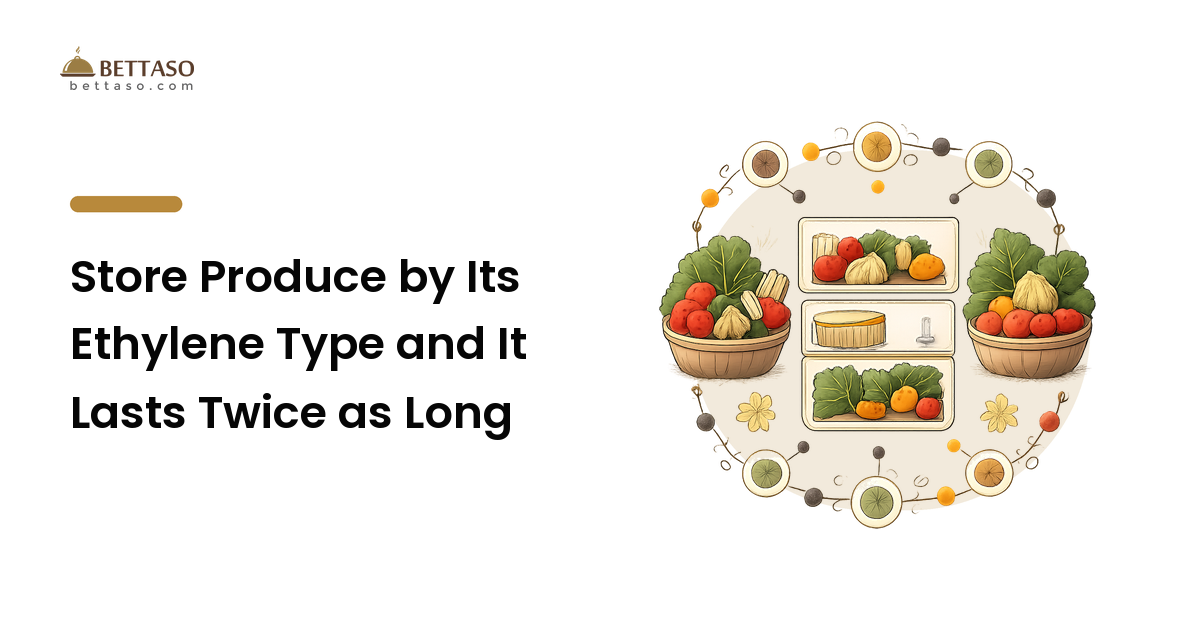
If your spinach turns to slime three days after a careful shop, the problem usually isn't your fridge or bad luck — it's a colorless, odorless gas called ethylene, and the fact that almost nobody stores food with it in mind. Here's the takeaway up front: stop sorting produce by where it grew or what aisle it came from, and start sorting it by whether it produces ethylene or reacts to it. Get that one split right and the same groceries last roughly twice as long.
This guide explains how ethylene actually works, gives you a simple two-bucket system you can run tonight, and walks through the storage mistakes that quietly cost you a third of your produce every week. If you also want to buy better in the first place, start with our guide on how to pick the freshest fruit and vegetables — good storage can only protect what was good when you bought it.
The hidden problem: one gas ages everything near it
Ethylene is a natural plant hormone that ripening fruit releases into the air. It's the signal that tells a fruit to soften, sweeten, and eventually rot — and it doesn't stay put. A few high-output fruits sitting in a closed drawer will gas everything around them, accelerating the aging of produce that would otherwise have kept for a week.
This is why a bag of apples turns the carrots next to them bitter and rubbery, and why one bruised peach can take down a whole bowl. The damage is invisible, so people blame the fridge, the store, or themselves. The actual cause is that ethylene producers and ethylene-sensitive items were stored together.
The trick: sort by producer vs. reactor, not by type
Forget "fruit drawer" and "veg drawer." Sort everything into two buckets:
Producers (high ethylene output): apples, bananas, avocados, tomatoes, peaches and other stone fruit, pears, mangoes, melons, ripe kiwi.
Reactors (highly ethylene-sensitive): leafy greens, broccoli, cauliflower, cucumbers, carrots, asparagus, green beans, herbs, lettuce, and most berries.
The single highest-value move in your kitchen is keeping these two groups apart. Producers go in one zone (a bowl on the counter, or one crisper drawer). Reactors go somewhere the gas can't reach them — ideally the second crisper drawer, on the opposite side. That's it. No special equipment, no gadgets.
Most fridges have two crisper drawers with humidity sliders precisely so you can run this split. Set the producer drawer to low humidity (vents open, letting gas and moisture escape) and the reactor drawer to high humidity (vents closed, holding moisture in for leafy things that wilt). The labels "crisper" and "low/high" finally make sense once you know what they're for.
A worked example: the same shop, two ways
Say you buy apples, a bunch of bananas, a bag of spinach, a head of broccoli, and a punnet of strawberries.
The common way: everything goes in the fridge, apples and spinach share a drawer, bananas sit in the fruit bowl next to the broccoli that didn't fit. Result: spinach slimes by day three, broccoli yellows by day four, strawberries fuzz over by day two. You throw out maybe a third of it.
The ethylene way: apples go in the low-humidity drawer or a separate bowl; bananas stay on the counter alone (they're heavy producers and chill-sensitive); spinach and broccoli go in the high-humidity drawer, dry and loosely covered; strawberries stay unwashed in a paper-towel-lined container in the fridge, washed only as you eat them. Result: greens last a week, broccoli stays tight, and you eat nearly all of it.
Nothing here costs money. The only change is where things sit relative to each other — and that's the whole point.
Common mistakes and why they backfire
Washing produce before storing it. Water on leaves and berries is the fastest route to mold and slime. Surface moisture feeds rot. Wash right before you eat, not before you store — and if greens came damp, dry them and add a dry paper towel to absorb the rest.
Sealing everything in airtight plastic. Most produce is still alive and respiring; sealed plastic traps both moisture and ethylene, creating a humid, gassy little spoilage chamber. Mushrooms in their plastic clamshell turn slimy fast; moved to a paper bag, they last for over a week. Herbs do better loosely bagged or stood in a glass of water like flowers.
Refrigerating things that hate the cold. Tomatoes, bananas, potatoes, onions, garlic, and basil all degrade in the fridge — tomatoes go mealy, potatoes turn gritty-sweet, basil blackens. These belong at cool room temperature, away from each other and from light.
Storing onions and potatoes together. A classic. Onions give off both moisture and gases that sprout potatoes faster, and potatoes return the favor. Keep them in separate, dark, ventilated spots.
People make these mistakes because the instinct — wash it, bag it, chill it, keep it tidy in one drawer — feels responsible. With ethylene and respiration in mind, each of those instincts is working against you.
Edge cases and caveats
- Use ethylene on purpose to ripen. The same gas that ruins greens can rescue a rock-hard avocado. Put it in a paper bag with a banana or apple; the trapped ethylene ripens it in a day or two. Take it out the moment it's ready.
- Cut produce changes the rules. Once cut, even low-ethylene items spoil fast and should be sealed and refrigerated — the protective skin is gone and air speeds decay.
- Berries are reactors but also fragile. Beyond keeping them from producers, a quick vinegar rinse (one part vinegar to three parts water) and a thorough dry can slow mold — but only if you dry them completely.
- "Heavy for its size" still rules at purchase. Storage protects freshness; it can't create it. A tired vegetable stored perfectly is still a tired vegetable.
The one move to remember
If you do nothing else: separate the producers from the reactors. Apples, bananas, tomatoes, and avocados in one place; leafy greens, broccoli, berries, and herbs well away from them. That single boundary prevents more spoilage than any container, gadget, or fridge setting — and it takes about two minutes to set up after each shop.
FAQ
Does ethylene really make that much difference?
Yes — it's the main driver of how fast many vegetables and delicate fruits age. Sensitive items stored next to heavy producers can spoil in a fraction of the time they'd last when separated. It's invisible, which is exactly why it gets overlooked.
Which fridge drawer should I use for what?
Use the low-humidity drawer (vents open) for ethylene-producing fruit like apples and pears, and the high-humidity drawer (vents closed) for leafy greens and vegetables that wilt. The humidity sliders control airflow, which lets gas and moisture escape or stay in.
Should I refrigerate tomatoes?
Not until they're fully ripe. Cold makes unripe tomatoes mealy and dulls their flavor. Keep them on the counter, stem-side down, and only chill a very ripe one for a day or two to buy time.
Why do my herbs and mushrooms die so fast?
Almost always sealed plastic. Both need to breathe. Store mushrooms in a paper bag and stand soft herbs in a glass of water (loosely covered) or wrap them in a slightly damp towel. Getting them out of airtight packaging often doubles their life.
Can I stop produce ripening completely?
No — and you wouldn't want to. The goal is to slow aging in sensitive items and control ripening in the producers, not freeze time. Separating the two groups and storing each at the right temperature and humidity is as far as ordinary kitchen storage can take you.
Next step
Open your fridge tonight and do one thing: pull the apples, pears, and tomatoes away from the leafy greens, and get your mushrooms and herbs out of sealed plastic. That two-minute sort is the difference between eating what you bought and binning a third of it — and once you store by ethylene type, fresh food simply lasts.